
Abstract
Mars, the furthest terrestrial planet in our solar system, has long intrigued astrobiologists due to its potential for hosting life and its significance for colonization efforts. So far, no evidence of past or present life exists on Mars. Still, the accumulated detected results indicate some biosignatures on Mars, such as organic matter and microstructures. We select essays and websites worth mentioning by analyzing their quality, evaluation, and influence, and mention their opinions in the articles to provide more credibility for the article. This paper presents the fundamental information about Mars, including its water history, atmospheric composition, magnetic field, and climate. We then conducted an in-depth analysis of Mars’ habitability by synthesizing findings from various detection techniques such as radar, spectroscopy, and imaging. Furthermore, we introduce the history of Mars exploration, highlighting critical missions and discoveries. We also address the challenges and potential solutions for human Mars colonization, alongside discussing the technology’s limitations of current technology and prospects for future research. This article provides a comprehensive overview of the progress and findings in Mars research, serving as a valuable contribution to planetary science and paving the way for future investigations on the red planet.
Introduction
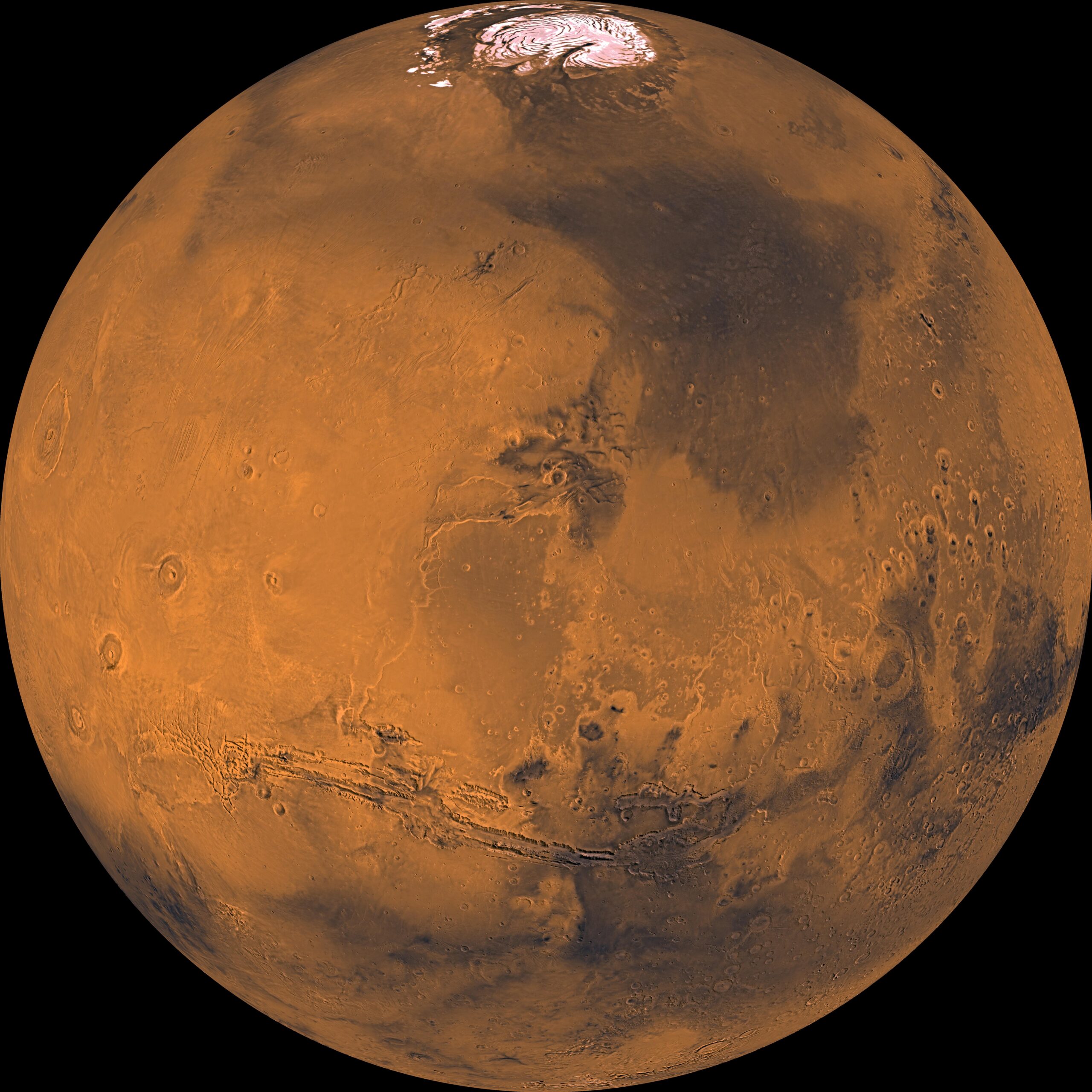
Mars is still our horizon for human exploration because it is one of the only other places we know of in the solar system where life may have existed ((NASA, Humans to Mars, https://www.nasa.gov/humans-in-space/humans-to-mars/#preparing.)). Mars is the fourth planet from the Sun and the farthest terrestrial planet in the solar system. Figure 1 shows a global color coverage of Mars at a scale of 1km/pixel deriving from Viking Orbiter red- and violet-filter images. Its mass is only 11% of Earth’s mass, its volume is 15% of Earth’s, its density is less than Earth’s, and its diameter is around half of Earth’s, giving it a gravity of 38% of Earth’s ((K. Lodders, B Fegley. The planetary scientist’s companion. (1998).)). Because of the similarity of the planet to early Earth, scientists have repeatedly asked the same, simple question over centuries: “Is it possible for Mars to form life?” Almost all modern theories hold that the presence of organic matter, a liquid medium, and an energy source were three necessary premises for life to first appear on early Earth ((K. Vladimir. The rise of a habitable planet: Four required conditions for the origin of life in the universe. Geosciences, 9(2), 92 (2019). www.mdpi.com/2076-3263/9/2/92.)). However, until now, the question remains unresolved due to lack of direct evidence. There is no concrete evidence of extant or historical life on Mars.
This paper will organize the basic data and information about Mars, integrate various pieces of evidence from various viewpoints within the academic field, present them clearly to the reader, and summarize them to a certain extent. Next, we will compare these conditions with those of early Earth in the aspect of the formation and development of early life forms and find out its impact. Then, we will briefly summarize the varieties of technology developed for exploring and studying Mars in order to review the footprints of human exploration of Mars. Afterward, we will analyze how the local environmental conditions can be an obstacle to human colonization and ways to overcome them. Finally, some experiments and plans will be presented, for instance, NASA’s numerous missions to study Mars deeper, as well as a hypothesis for colonizing Mars.
By this summarization, we hope to provide contributions to the field of planetary science, pave the way for future related research, and enable further exploration and deeper understanding of Mars. Besides, we want to raise the attention of the general public to this topic for future astronomical research, keep the public informed of current research progress, and give them a general idea of future developments.
Exploring Mars’s Environment
Mars’s Water History
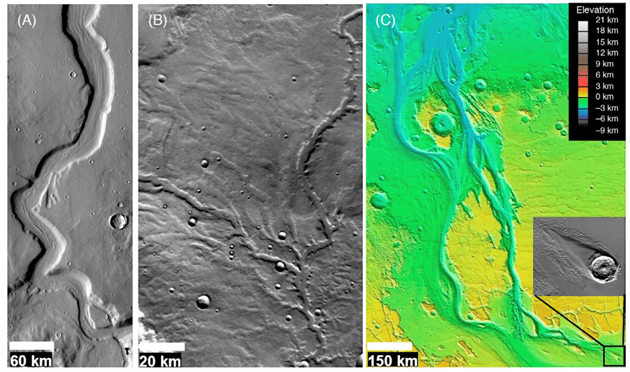
The possibility of past or present life existence is significantly influenced by the presence of potential water and its historical evolution. It is believed that water existed on Mars’ surface throughout the Noachian (4.1–3.7 billion years ago) and Hesperian (3.7–3.2–2 billion years ago) periods, indicating that Mars was warmer and wetter in the past ((B. M. Hynek, M. Beach, & M. R. Hoke, Updated global map of Martian valley networks and implications for climate and hydrologic processes. Journal of Geophysical Research: Planets, 115, (2010).))’ ((B. M. Jakosky, R. J. Phillips, Mars’ volatile and climate history. Nature. 412(6843), 237-244 (2001).)). Furthermore, the surface of Mars is crisscrossed with riverbeds, canyons, channels, and other features that many scholars believe are proof that liquid water once existed. For example, figure 2 shows different types of channels. Today, the temperature and pressure on Mars are too low for liquid water to exist. Most of the water ice on Mars is located in the polar regions, which are covered with ice caps that stretch for millions of square kilometers and are thousands of meters thick. Mars observation data also further confirmed that the polar areas are covered with a lot of water ice ((J. P. Bibring, Y. Langevin, F. Poulet, et al. Perennial water ice identified in the south polar cap of Mars. Nature. 428(6983), 627-630 (2004).)).
Assessing the current content and state of liquid water on Mars has become one of the driving forces for its exploration. Many scholars have different opinions about whether liquid water exists at the bottom of Mars’ south polar ice cap. Researchers used radar data from the Mars Express mission of ESA and geological and mineralogical evidence to analyze this region ((A. R. Khuller, J. J. Plaut, Characteristics of the Basal Interface of the Martian South Polar Layered Deposits. Geophysical Research Letters, 48(13), e2021GL093631 (2021).))’ ((R. Orosei, S. E. Lauro, E. Pettinelli, et al. Radar evidence of subglacial liquid water on Mars, Science, 361, 490-493 (2018).)). The results suggest that there could be a lake of liquid water under the ice cap, but this area’s average annual surface temperature is too low even for supercooled perchlorates to remain liquid, so the area also may not be liquid water. These results indicate that the South Pole may have a complex hydrological system, which has aroused wide discussion and concern among scientists.
Constituents of the Atmosphere
Mars has a unique atmosphere because it lost its magnetosphere perhaps as a result of an asteroid hit 4 billion years ago ((C.Q. Choi, Mars: Everything you need to know about the red planet. https://www.space.com/47-mars-the-red-planet-fourth-planet-from-the-sun.html
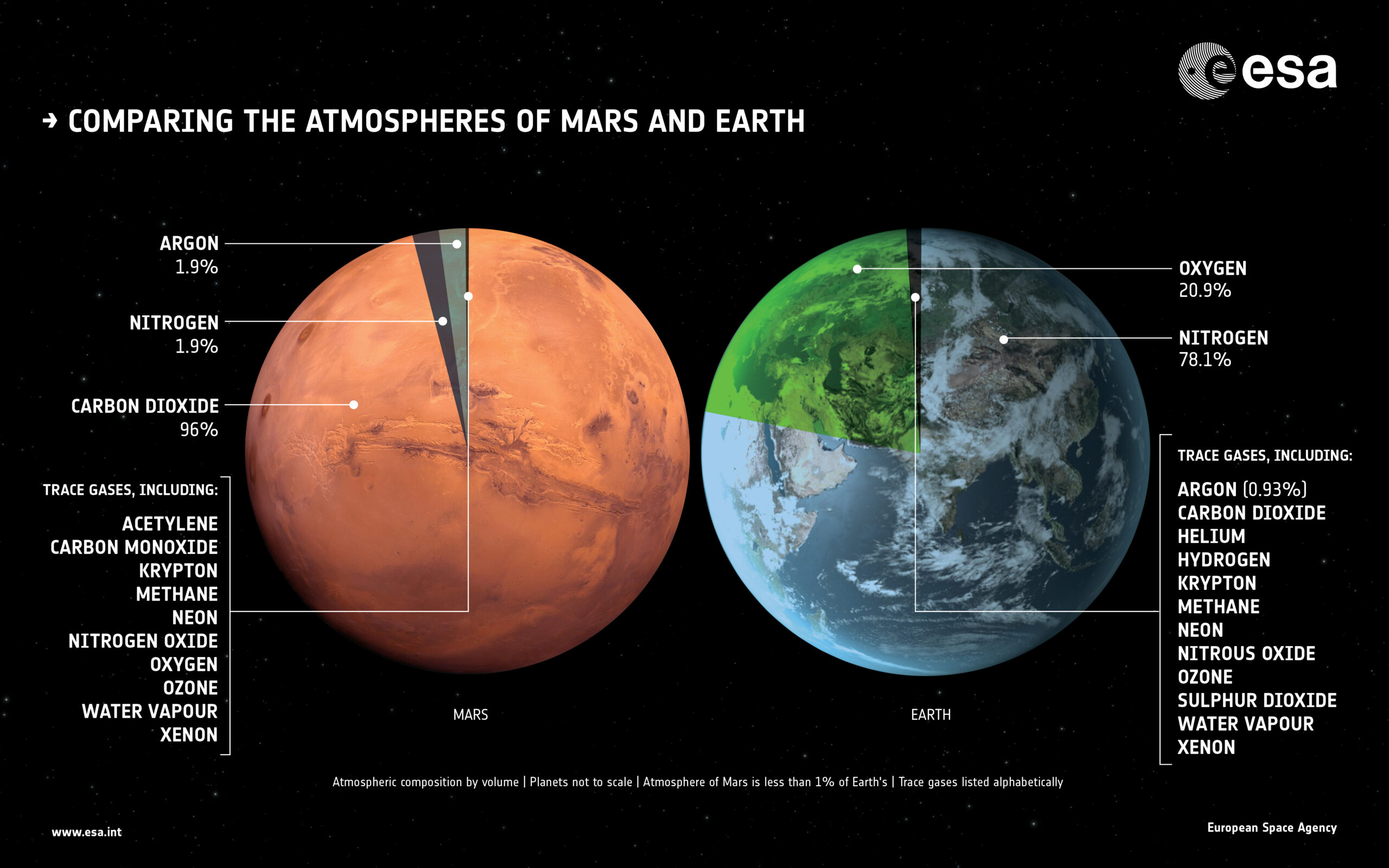
(2023).)). Consequently, the solar wind emanating from the Sun directly interacts with the Martian ionosphere and removes atoms from its atmosphere’s outer layer ((B. M. Jakosky, How did Mars lose its atmosphere and water?” Physics Today, 75, 62–63 (2022).)). As shown in Figure 3, the atmospheres of Mars and Earth are quite different in composition: Mars is primarily carbon dioxide-based, while Earth is rich in nitrogen and oxygen ((The European Space Agency, Comparing the atmospheres of Mars and Earth, https://www.esa.int/ESA_Multimedia/Images/2018/04/Comparing_the_atmospheres_of_Mars_and_Earth (2018).)). Approximately 96 percent of Mars’ atmosphere is made up of carbon dioxide, 1.93% argon, and 1.89% nitrogen, with fewer quantities of oxygen and water, as well as a significant quantity of dust made up of rock fragments, minerals, and other small particles ((P. R. Mahaffy, et al. Abundance and isotopic composition of gases in the Martian atmosphere from the Curiosity rover. Science, 341, 263–266 (2013).)).
Even so, there are still substances that are beneficial for biological forms of life. There is persistent methane in the Mars air. Since methane in Mars’ present atmosphere is unstable chemically because of the UV radiation from the sun and other chemicals, scientists conclude that methane is persistent in the atmosphere ((S. K. Atreya, et al. Methane and related trace species on Mars: Origin, loss, implications for life, and habitability. Planetary and Space Science, 55, 358-369 (2007).)). Formaldehyde is also found in Mars’s atmosphere. These are potential evidence of life forms on this planet because these nutrients can be used by life forms.
Effect of Mars’s Core and Magnetic Field
Mars’s core is made up of dense material with a radius of 1,700 kilometers, a layer of molten rock that is wider than the mantle layer of Earth, and a thin shell primarily composed of rock and regolith as its outermost covering. Mars doesn’t possess dynamic plate motion, resembling Mercury and the moon of Earth. Near 4.5 billion years prior, alterations to Mars’ internal structure caused its core to stop moving for inclusive reasons, ultimately leading to the disappearance of Mars’ magnetic field ((W. Riedler, D. Möhlmann, V. N. Oraevsky, et al. Magnetic fields near Mars: First results. Nature, 341(6243), 604-607 (1989).)). Without a magnetic field, Mars is unable to defend itself from potentially dangerous cosmic radiation, solar radiation, and UV radiation, which makes Mars a harsh place for creatures to survive. These changes significantly degraded the surface’s habitability.
Martian Seasons and Climate
Because of the similar tilts of their rotating axes, Mars’s seasons are the most equivalent to Earth’s among any of the planets in the Solar System ((Wilson, J. W. Shielding strategies for human space exploration. No. NAS 1.55: 3360 (1997).)). Since Mars is further from the Sun, its seasons are nearly twice as long as Earth’s, and as a result, the Martian year is roughly twice as lengthy as Earth’s. The temperature of the Martian surface fluctuates between frigid temperatures of -110°C to a somewhat warmer 35°C in the Martian summer because not much heat from the sun can be maintained within the thin atmosphere. Heat dissipation is also exacerbated by the low air pressure and thermal inertia of Martian soil ((M. Grott, T. Spohn, J. Knollenberg, et al. Thermal conductivity of the Martian soil at the InSight landing site from HP3 active heating experiments. Journal of Geophysical Research: Planets, 126(7), e2021JE006861 (2021).)). The winds stretch up to roughly fifty latitudes throughout the northern winters on Mars, according to research on the Hadley circulation of the planet. The Martian trade winds pass the equator during the solstice seasons, bend eastward, and create a low-elevation eastward stream in the summer subtropics. Strong surface winds are a result of these occurrences ((C. Leovy, Weather and climate on Mars. Nature, 412, 245-249 (2001).)). Intense sandstorms on Mars make its weather additionally inhospitable. Huge temperature differences and frequent extreme climates prevent life from forming and developing.
Mars Habitability Requirements
Potential Life-Sustaining Conditions on Mars
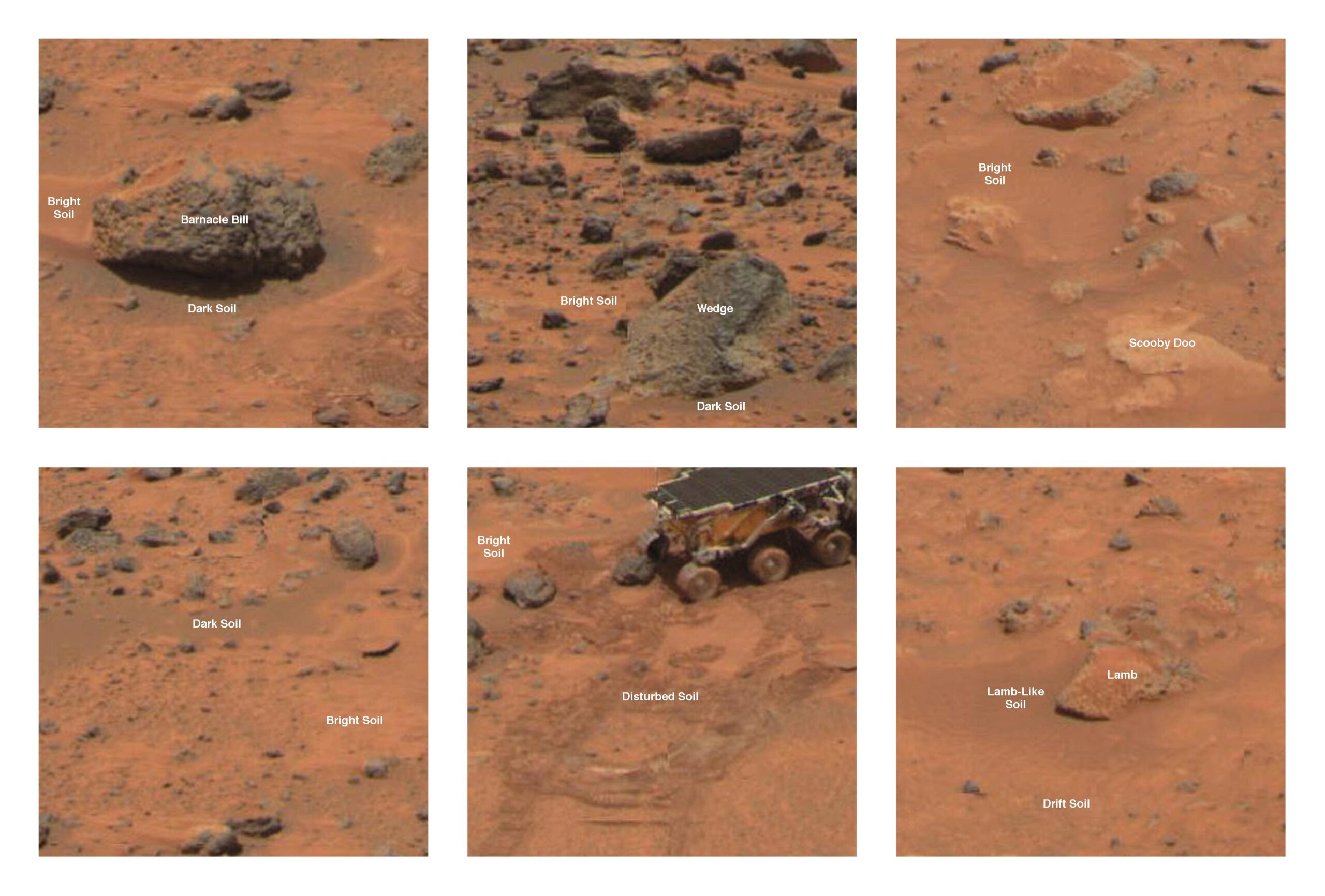
There are all kinds of geographical structures on Mars’s surface- volcanoes, caves, craters, and valleys. On the Martian surface, there are red fine-grained and breccia debris, fragments of a specific rock. Figure 4 illustrates some types of rocks and soils on the surface of Mars. Their chemical composition is mainly oxygen, silicon, and iron. These structures are also composed of other compounds such as ferric oxide, aluminum oxide, silicon oxide, and calcium oxide ((J. F. Bell III, H. Y. McSween Jr, JA Crisp, et al. Mineralogic and compositional properties of Martian soil and dust: Results from Mars Pathfinder. Journal of Geophysical Research: Planets, 105(E1), 1721-1755 (2000).)). The somewhat alkaline soil of Mars consists of essential nutrients including potassium, sodium, magnesium, and chloride. Preserving organic materials is essential to comprehending Mars’s biological potential over time.
Whether it serves as a repository of past life, sustenance for existing life forms, or has endured in lifeless environments, organic matter in Martian substances provides valuable chemical insights into planetary conditions and mechanisms ((J. L. Eigenbrode, R. E. Summons, A. Steele, et al. Organic matter preserved in 3-billion-year-old mudstones at Gale crater, Mars. Science, 1096-1101 (2018).)). Analysis of Martian soil samples by rovers like Curiosity has revealed the presence of essential elements for life, such as carbon, hydrogen, nitrogen, oxygen, phosphorus, and sulfur ((P. R. Mahaffy, et al. The sample analysis at Mars investigation and instrument suite. Space Science Reviews, 170, 401–478 (2012).)). These elements are fundamental building blocks for organic molecules and are necessary for life processes. From another aspect, meteorites are another persuadable evidence for life. Microscopic morphological features thought to be biomorphs are found in “ALH84001”, organic compounds similar to Earth’s on “The Nakhla”, and certain features pointing to remnants of life on “The Shergotty” ((D. S. McKay, et al. Search for Past Life on Mars: Possible Relic Biogenic Activity in Martian Meteorite ALH84001. Science, 273, 924–930 (1996).))’ ((C. Meyer. Mars Meteorite Compendium: 1998. National Aeronautics and Space Administration, Lyndon B. Johnson Space Center (1998).)). These findings provide indirect evidence for the possibility of life on Mars.
Moreover, there is evidence for the presence of life, however; In 2013, NASA revealed that according to data newly collected from their rover “Curiosity” on Mars, millions of years ago, a crater that contained an old freshwater lake would have offered an ideal habitat for microorganisms ((K. Chang, On Mars, an ancient lake and perhaps life. New York Times (2013).)). This study primarily conducted a morphometric analysis to investigate the microalgae-like microstructures inside this crater ((G. Bianciardi, T. Nicolò, L.Bianciardi, Evidence of Martian microalgae at the Pahrump Hills field site: A morphometric analysis. Journal of Astrobiology and Space Science Review, 70-79 (2021).)). These findings support the evidence that these microstructures could be fossils of Martian microalgae, which provide new evidence and perspectives on the potential existence of life on Mars.
In the scientific journal “Frontiers in Microbiology”, a report by scientists from NASA The study claims for the first time that Anabaena cyanobacteria may be cultivated at low atmospheric pressure using just ambient gasses, water, and other nutrition, just like in Martian surface conditions. The results indicate that cyanobacteria are capable of utilizing gases present in the Martian atmosphere, even at low total pressure, as sources of both carbon and nitrogen. This suggests that cyanobacteria might thrive in water with Mars-like dust, especially considering nitrogen-fixing cyanobacteria’s ability to produce oxygen. Cultivating them on Mars with local resources and low pressure could significantly advance the quest for Martian life and food production opportunities ((C. Verseux, C. Heinicke, et al. A low-pressure, N2/CO2 atmosphere is suitable for cyanobacterium-based life-support systems on Mars. Frontiers in Microbiology, 12 (2021).)).
Surviving on Mars: Basic Needs and Challenges
In science-fiction movies, we often see astronauts living in bases built on Mars. Indeed, there are lots of conditions required for people to survive. The most important diet is water because, without water, humans can only live for three to five days. Besides, humans need different kinds of food such as carbohydrates, protein, and vitamins, to provide nutrition. For air, humans need ample oxygen. Furthermore, humans have to live in a contract wet environment. They also need substances to keep them from all kinds of deadly cosmic radiation. For temperature, humans can only survive in strict conditions, which are between 10 to 30 degrees Celsius.
Apart from some basic requirements above, addressing critical challenges such as radiation exposure, the psychological effects of long-duration space travel, and the sustainability of life support systems is paramount for the successful colonization of Mars.
Firstly, radiation exposure poses a significant risk to astronauts during their journey to Mars and while on the Martian surface due to the lack of a protective atmosphere and magnetic field. High-energy cosmic rays and solar radiation can cause DNA damage, increasing the risk of cancer and other health issues ((M. Durante, F. A. Cucinotta, Heavy ion carcinogenesis and human space exploration. Nature Reviews Cancer, 8, 465-472 (2011).)). Therefore, the development of advanced shielding materials is of great significance. Researchers are exploring novel materials to shield astronauts from harmful cosmic and solar radiation during space travel and while on the Martian surface ((Wilson, J. W., et al. Shielding strategies for human space exploration. No. NAS 1.55: 3360 (1997).)).
Secondly, the psychological effects of long-duration space travel, including isolation, confinement, and the monotony of life in a confined spacecraft, can lead to mental health issues such as depression, anxiety, and decreased cognitive function ((N. Kanas, D. Manzey, Space psychology and psychiatry. 16, El Segundo, CA: Microcosm Press (2008).)). Maintaining crew morale and mental well-being will be crucial for the success of a Mars mission. Thus, people must implement comprehensive psychological support systems, including counseling services, virtual reality simulations, and communication platforms, to address astronauts’ mental health and well-being during extended missions.
Lastly, ensuring the sustainability of life support systems is essential to provide astronauts with the necessary resources, including oxygen, water, and food, for their survival on Mars. Developing reliable and efficient life support technologies that can operate autonomously for extended periods is critical, as resupply missions from Earth will be infrequent and costly. A Closed-loop life support system is crucial. Researchers are devoted to designing self-sustaining life support systems that recycle and regenerate essential resources such as water, oxygen, and nutrients using advanced technologies like biological waste recycling, hydroponic farming, and atmospheric processing ((A. A. Menezes, M. G. Montague, J. Cumbers, et al. Grand challenges in space synthetic biology. Journal of The Royal Society Interface, 12(113), 20150803 (2015).)).
Advancements in Mars Colonization Technology
Though there exist many barriers to long-term survival on Mars, scientists have already developed technology that may improve the planet’s habitability. Besides fundamental equipment like spacesuits and capsules, new energy resources such as nuclear fusion are being discovered, the most cutting-edge technologies are being used on rockets to enhance their speed, and simulation experiments are being done for research results. The development of more efficient means of producing water and grains is crucial too since astronauts can only bring limited resources each time. Laboratories on Earth are conducting experiments to find better survival methods, and facilities including satellites, spaceports, and telescopes are observing Mars for more detailed information. Astronauts receive training in Antarctica, where its climate, landform, and temperature parallel the conditions of isolation astronauts will face in long-duration missions ((NASA, Antarctic Stations. www.nasa.gov/mission/antarctic-stations (2023).)). The ambitious target of colonizing Mars continually stimulates humans to improve our technologies.
Evolution of Mars Exploration: 60 Years of Scientific Progress
In the 60 years of human exploration of Mars, outstanding scientists and researchers have sent many instruments to Mars for detecting missions. The first unmanned detector sent to Mars in 1962 was The Soviet Union’s detector “Mars-1”, which was the beginning of modern exploration of Mars ((NASA, Mars 1. https://nssdc.metgsfc.nasa.gov/nmc/spacecraft/display.action?id=1962-061A)). “Mariner 4” from the United States is the first probe to reach Mars successfully. In 1965, this spacecraft completed its inaugural successful approach to Mars and brought back the first images of the planet’s surface ((NASA, Mariner 4. https://science.nasa.gov/mission/mariner-4)). Since then, increasingly more rovers have been launched to Mars for various research purposes.
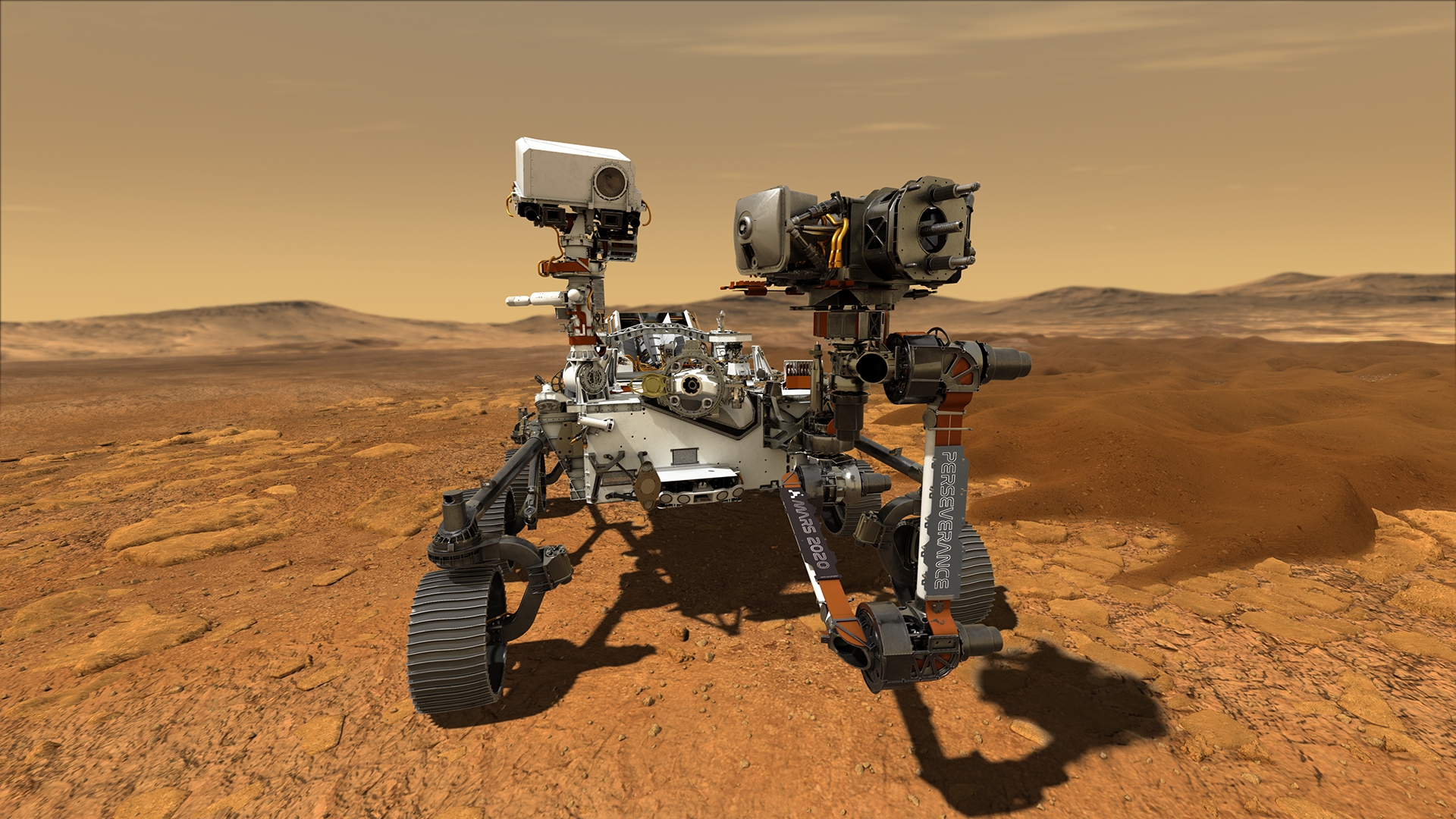
For instance, the Viking orbiters discovered indicators of potential river channels, erosion, and branched streams on Mars’s surface ((NASA, Viking Project. https://science.nasa.gov/mission/viking/)). In an effort to find a potentially livable location among the Martian regolith, some distance under the surface where microbial life could exist, the Phoenix mission successfully brought down an automated spacecraft in the arctic zone of Mars. It also studies the geological history of water on Mars. A mechanical vehicle fueled by nuclear energy, the Curiosity rover’s mission is to assess if Mars is habitable ((NASA, Mars Phoenix. https://science.nasa.gov/mission/mars-phoenix))’ ((NASA, Curiosity Rover Science. https://science.nasa.gov/mission/msl-curiosity/science)). Other detectors, such as Insight, Mars Cube One (Marco), and Perseverance Rover, shown in Figure 5, move to a predetermined position or collect data ((K, Chang, NASA’s InSight Mission Has Touched Down on Mars to Study the Red Planet’s Deep Secret. The New York Times (2018).))’ ((NASA, NASA Prepares for First Interplanetary CubeSat Mission. https://www.nasa.gov/news-release/nasa-prepares-for-first-interplanetary-cubesats-on-agencys-next-mission-to-mars (2015).))’ ((NASA, Mars 2020: Perseverance Rover. https://science.nasa.gov/mission/mars-2020-perseverance)). China’s Tianwen-1 mission, successfully launched in 2020, is conducting detailed scientific research on the surface, atmosphere, and geological structure and is expected to yield valuable insights that will advance humanity’s understanding of Mars ((Y. Zou, Y. Zhu, Y. Bai, et al. Scientific objectives and payloads of Tianwen-1, China’s first Mars exploration mission. Advances in Space Research, 67(2), 812-823 (2021).)). Our knowledge of Mars is increasingly profound.
Discussion
Mars vs Earth: Life Formation Comparison
Mars and Earth are the only two planets in the solar system’s habitable zone. However, the early progress of life-forming on both planets is still confusing due to numerous differences like the distance to the fixed star, chemical composition, and rotation situations. According to genetic evidence, the last universal common ancestor (LUCA), who lived far back in evolutionary history, shared many characteristics with modern life and thrived in an anoxic environment, characterized by low oxygen levels and abundant H2, CO2, and geochemically active iron ((M. D. Cantine, G. P. Fournier, Environmental Adaptation from the Origin of Life to the Last Universal Common Ancestor, Origins of Life and Evolution of Biospheres, 48, 35-54 (2018).)).
Dehydration synthesis, the way cells organize together, is crucial to forming metabolic and other substances necessary for life. However, the early Earth was an “Ocean World”, which did not enhance life formation, restricting the process to regions such as volcanic island hot spots ((N. Kitadai, S. Maruyama, Origins of Building Blocks of Life: A Review. Geoscience Frontiers, 9, 1117-1153 (2018).)). In contrast, with more land, Mars is a more suitable place to create life at that time. Additionally, the evolution of the genetic code and the abundance of amino acids on Earth indicate that they have previously been subjected to oxidizing environments. However, geologic records demonstrate that throughout the planet’s first two and a half billion years, oxygen was essentially absent. It is widely believed that life on Earth formed 3.8 billion years ago, perhaps before the existence of CH4 and NH3 in the Earth’s atmosphere. Oxygen appeared in large quantities only during the Great Oxidation Event, which occurred 2 billion years ago ((J. F. Kasting, Earth’s Early Atmosphere. Science, 259, 920-926 (1993).)). Once more, the surface of Mars began to oxidize greatly earlier, supporting the previous hypothesis that they may have come from Mars initially ((C. E. Carr, Resolving the History of Life on Earth by Seeking Life as We Know It on Mars. Astrobiology, 22, 880-888 (2022).)).
Evidence suggests that early Mars had the requirements to form life, and the ejecta material from large impact events made it possible to transfer viable life from Mars to Earth ((D. Schulze-Makuch, A. G. Fairén, A. F. Davila, The case for life on Mars. International Journal of Astrobiology, 7.2, 117-141 (2008).)). The hypothesis of life transferring between Mars and Earth within meteoroids is reinforced by the extremely high survival intensity of certain microorganisms, such as cyanobacteria ((C.S. Cockell, et al. Interplanetary transfer of photosynthesis: an experimental demonstration of a selective dispersal filter in planetary island biogeography. Astrobiology, 7.1, 1-9 (2007).)). As mentioned before, the Martian meteorite “ALH84001” that landed on Earth contains microscopic morphological features that some scientists identified as traces of biomorphs ((D. Stöffler, et al. Experimental Evidence for the Potential Impact Ejection of Viable Microorganisms from Mars and Mars-like Planets. Icarus, 186, 585-588 (2007).)). After arriving on Earth, they may have quickly adapted to the environment here and evolved from there. Nevertheless, there isn’t sufficient proof to back up this theory.
As mentioned previously, there are conditions for extraordinary bacteria to survive. For instance, there are geysers on Mars’s surface. The most noticeable facets of the geysers, the dark dune areas, and the spider tunnels could be representing colonies of photosynthetic Martian microbes, according to a team of Hungarian academics. They inferred that these organisms lie beneath the ice caps in winter, and when the sunlight reaches the polar regions at the beginning of spring, it gets through them. Thus, the microbes warm their environment by photosynthesizing ((A. Horváth, T. Gánti, A. Gesztesi, Sz. Bérczi, E. Szathmáry, Probable Evidence of Recent Biological Activity on Mars: Appearance and Growing of Dark Dune Spots in the South Polar Region. 32nd Annual Lunar and Planetary Science Conference, 32, 1543 (2001).))’ ((T. Pócs, A. Horváth, T. Gánti, Sz. Bérczi, E. Szathemáry, Possible Crypto-Biotic-Crust on Mars? Proceedings of the Third European Workshop on Exo-Astrobiology, 545, 265–266 (2004).))’ ((T. Gánti, et al. Dark Dune Spots: Possible Biomarkers on Mars? Origins of Life and Evolution of the Biosphere, 33, 515–557 (2003).)). In addition, researchers declared the finding of an unknown “dark microbiome” of microbes in Chile’s Atacama Desert, a place that is similar to the surface of Mars ((The Washington Post, Strange DNA Found in the Desert Offers Lessons in the Hunt for Mars Life. https://www.washingtonpost.com/science/2023/02/21/mars-life-atacama-microbiome (2023).))’ ((A. Azua-Bustos, et al. Dark Microbiome and Extremely Low Organics in Atacama Fossil Delta Unveil Mars Life Detection Limits. Nature Communications, 14, 808 (2023).)).
Limitations and Future Investigation
Although we have discussed the challenges and their possible solutions above, researchers need to do plenty of future work due to the limitations of current technologies. For instance, for the propulsion systems, current propulsion technologies, such as chemical rockets, are limited in their efficiency and speed for transporting payloads to Mars. Future work involves the development of advanced propulsion systems, such as nuclear thermal propulsion or ion propulsion, to reduce travel time and increase payload capacity. For life support systems, designing robust life support systems capable of sustaining human life in the Martian environment is crucial. Future research aims to improve recycling and regeneration technologies for air, water, and food, and develop closed-loop systems that minimize resource consumption and waste generation. Protecting astronauts from the harmful effects of cosmic and solar radiation on Mars is a significant challenge for radiation protection. Future work involves developing lightweight yet effective radiation shielding materials and designing habitats with built-in radiation protection measures.
Addressing the challenges mentioned above requires interdisciplinary collaboration and innovation. It will also require rigorous testing and validation of these systems in analog environments on Earth before embarking on crewed missions to Mars.
Future Mars Colonization Missions
There will be missions in the near future to continue the discovery. For instance, the Dutch company Mars One, whose plan is to launch astronauts to Mars, will travel in 2027 ((NPR: Science. K. Nnamdi, One-way Mission to Mars. https://thekojonnamdishow.org/shows/2015-02-25/one-way-mission-to-mars (2015).)). Besides, Tianwen-3 is a planned Mars sample return mission organized by China. The mission plans to land on the surface of Mars in 2028, gather samples, and bring them back to Earth by approximately 2030 ((J. Zhao, et al. Geological diversity of paleolakes in the NW Arabia Terra, Mars: implications for Tianwen-3 sample return mission. Copernicus Meetings, No. EGU24-11596 (2024).)). Moreover, planned for the 2030s, the goal of NASA’s Orion project, the first project since Apollo, is to send and bring back astronauts to Mars via deep space travel ((Mars Daily, NASA aims to put a man on Mars by 2037. https://www.marsdaily.com/reports/NASA_aims_to_put_man_on_Mars_by_2037_999.html (2007).)). Escape and Plasma Acceleration and Dynamics Explorers (EscaPADE), an orbiter voyage to Mars to investigate the dynamics, structure, fluctuation, and architecture of the planet’s atmosphere and magnetosphere, and ExoMars Rover, a combined Russian-European expedition to look for evidence of possible life on Mars, these plans bring hope for further research ((NASA, EscaPADE. https://nssdc.gsfc.nasa.gov/nmc/spacecraft/display.action?id=ESCAPADE (2022).))’ ((European Space Agency, ExoMars Rover. https://www.esa.int/Science_Exploration/Human_and_Robotic_Exploration/Exploration/ExoMars/ExoMars_rover)).
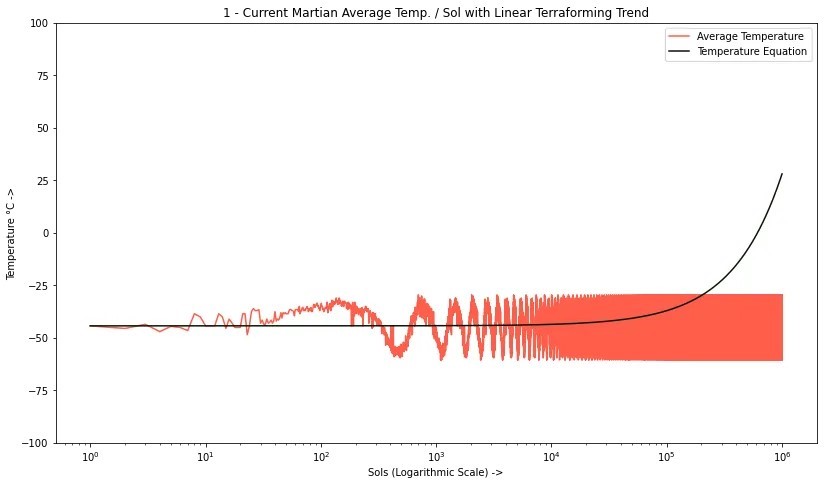
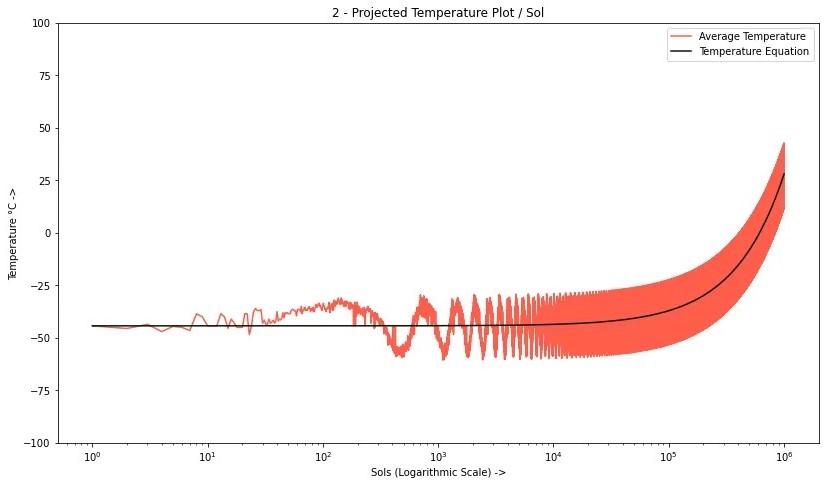
A study by researcher Akash Sonthalia shows that it might take a million years on Mars to terraform the skin temperature on Mars, raising it to the ideal temperature for humans to survive ((A. Sonthalia, Terraforming Mars — A Data Science & Engineering case study using Python, Apache Spark & Apache Airflow on AWS. Medium. https://medium.com/@akashsonthalia/terraforming-mars-a-data-science-engineering-case-study-using-python-apache-spark-apache-e9370a039276 (2021).)). Figure 6 plots the projected atmospheric conditions of Mars. Although it is possible for humans to colonize Mars in the future, we may only live on the base.
Conclusion
This article primarily discusses the impact of the Martian environment, such as atmosphere and water conditions, on the emergence of life and human colonization, compares the conditions for life formation between Mars and Earth, provides basic information and data about Mars, analyzes obstacles to human colonization on Mars and proposes solutions. Additionally, it summarizes the technologies and achievements in Mars exploration and research and outlines future research and human colonization plans on Mars.
Mars colonization is a complex and uncertain endeavor, involving various challenges and uncertainties in technology, life support systems, psychological well-being, social and political factors, as well as moral and ethical considerations. The extreme Martian environment presents significant challenges for human survival and infrastructure development, while long-term confinement in enclosed spaces may impact astronauts’ psychological health. Additionally, Martian colonization entails social and political issues such as international cooperation, resource allocation, power structures, and ethical considerations regarding the extraterrestrial environment and the potential existence of life. Therefore, critical discussions and comprehensive measures are required to address the myriad of possible problems and challenges associated with Mars colonization.